The Awe of Angkor
8 min read
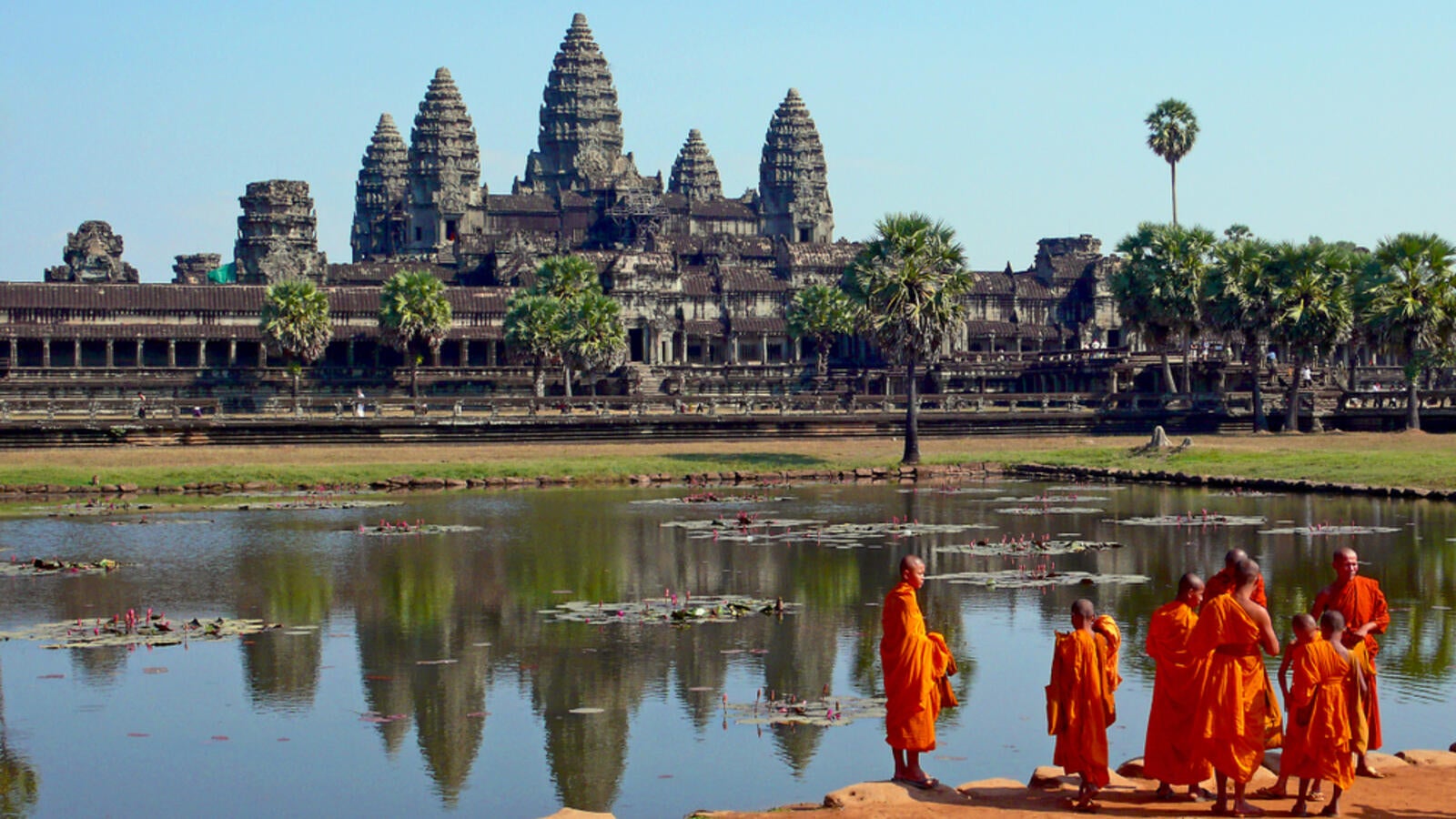
Built between 800 – 1300 AD the sprawl of the ruins of Angkor Wat, the seat of the Khmer Empire, covering an area of over 400 sq kms. is arguably one of the world’s largest awe inspiring ancient cities .
I was trying very hard to suppress my inner Indiana Jones actually. But Angkor pushes that to a very heightened state. It calls for intrigue and adventure, sidling along crumbling stone walls, swinging across obstacles o vines, tumbling off steep ramparts and other essential ingredients of a summer blockbuster.
The Empire
The sprawl of Angkor , the seat of the Khmer Empire, covers an area of over 400 sq kms.- arguably one of the world’s largest ancient cities. Just like the name (Angkor is a derivative of the Sanskrit nagara or city), much of the architecture of this region draws it’s influences from India. Infact Hinduism was the state religion for a while, until a gradual conversion to Mahayana Buddhism, which led to a curious mash-up of religious expression. Seven headed nagas (snakes) stand guard at every gate and entrance, often accompanied by a Garuda (a large mythical bird) – the two though enemies in Hindu mythology symbolise peace to Cambodians when depicted together. Lingams and yonis are common features within temples, and the familiar forms of Brahma, Vishnu & Shiva occasionally appears alongside Buddha, although with more Cambodian features than I’m used to seeing.
Nowhere is this more prominent than at Angkor Wat, the phenomenal heart of the kingdom. Build as a Hindu temple dedicated to Vishnu the wat is almost beyond description. First off it’s huge and huge in a way that whales are – you know how big they’re supposed to be but until you actually meet one, you never quite believe that things come in that size. Whats most impressive though, is the detailing that covers every inch of stone here . Intricate bas-relief depictions of the Mahabharata and the Ramayana line corridors – the segment narrating the churning of the sea of milk is most famous – and apsaras smile from the walls at every turn. There aren’t many Hindu idols left within the complex (now a practising Buddhist temple) though you’ll encounter the odd lingam here and there.
Translating the Architecture
At first glance it looks a supersized version of the temples you see across south India and the complex is modelled after the concept of Mount Meru – the centre point of the universe in Hindu lore. There are five towers surrounded by galleries, walls and a moat, representing the five peaks of the mountain and the ocean beyond. He central tower (rather more exclusive in it’s heyday and tough to climb up even now) rises highest and though a few idols remain there now, the stairs are worth tackling for the views and the serenity. Theres quite a bit of jostling to be done to get to that serenity tough – Angkor Wat sees a lot of tourist traffic. And it helps to prepare yourself before you arrive, or time you visit to avoid the worst of the rush (in the afternoon hours when it’s also the hottest). Or of course you can look at different ways to see it. Theres also a hot air balloon ride at a ridiculously cheap Rs 800 over the complex and decided to give it a go. What it was , though was a slightly nauseating 15 minute ride up in a tethered balloon with no hot air in sight. Worth it only if you grab a sunset slot on a clear day (sunrise trips very often don’t take off due to high wind speeds) – you’ll get an ariel view of the wat bathed in orange hues.
Many Khmer kings built the amazing temples, defence walls and reservoirs. The Angkor period began with the rule of King Jayavarman II who was responsible for a vast number of the monuments and temples. He built many temples for himself, his mother and father. King Indravarman I was responsible for building the 650 hectares of reservoirs. This was a massive irrigation system that provides water to most of the Angkor Wat areas. It was because of this reservoir that Angkor Watt could sustain and support its large population. Suryavarman II was responsible for the construction of the most famous temple, Angkor Wat temple. It was constructed in the late 12th to early 13th century. This temple is the pride of the Cambodian people, as it stands on their national flag.
And then theres Angkor Thom. The royal city within Angkor and capital of the empire, Angkor Thom is full of yet more temples, including the Bayon which best reflects the move from Hinduism to Mahayana Buddhism as the state religion. The last state temple to be build in Angkor- Bavon is most known for the many faces of the Buddha looking out peacefully in all directions from the temple towers. But what I liked best at Angkor Thom was the terrace of elephants. A long raised platform on which king once sat. Across the way from the terrace theres a line of intricately carved towers. When this was a living city , acrobats would run lines across these towers performing stunts for his majesty’s entertainment.
Exploration
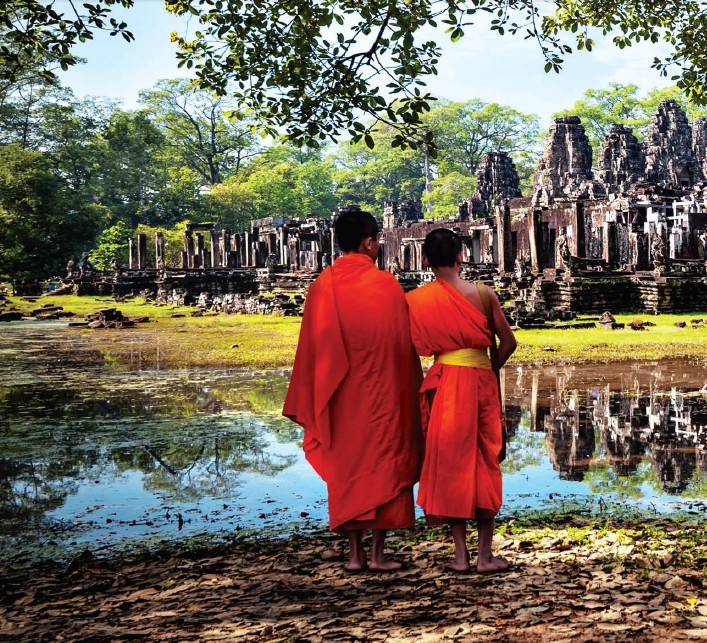
A day or two gives you enough time to explore the ruins at the centre of Angkor – there are Vishnu and shiva temples, funerary temples, Buddhist temples and even the overgrown Ta Prohm of Lara Croft fame. One of the major temples of Jayavarman VII -in fact, a temple-monastery-Ta Prohm features a set of concentric galleries with corner towers and gopuras, but with many other additional buildings and enclosures. The complex city of its lay out is increased by its partly collapsed state, with trees interlaced among the ruins. According to its steel, which until recently was In situ, the principle divinities of Ta Prohm were installed 1186 to transfer merit the king’s mother the principle deity, prajnaparamita, the (perfection of wisdom) was carved in her likeness (similarly, the Principe deity of Preah Khan, Lokesvara, was carved in the likeness of – The king’s father). This was only five years after Jayavarman’s accession, making it clear that much of the building work took place throughout and after his reign. Ta Prohm’s original name was Rajavihara (the royal monastery). In the initial plan for Ta Prohm, 260 divinities were called for; many more were added later, this was the temple chosen by the Ecol Francaise d’extreme – Oreint to be left in its natural state as an example of how most of Angkor looked on its discovery in the 19th Century. This was an inspired decision, and involved a significant amount of work to prevent further collapse and enough clearing of vegetation to allow entry. It has been maintained in this Condition of apparent neglect – thats partly overgrown and gently declining. The trees that have grown intertwined among the ruins are especially responsible for Ta Prohm’s atmosphere, and have undoubtedly prompted more writers to descriptive excess than any others though.
Theres another temple thats worth staying an extra day for. About 70 kms out of Siem Reap ( the city closest to Angkor) lies the Beng Mealea temple and this is where I really looked forward to flash my whip and fedora. Towards the end of the 15th century with the fall of Angkor Beng Mealea was razed by invaders from Siam (modern day Thailand) who rode their elephants through the temple almost completely destroying it. The jungle has really taken over here and not in the seeming organised way that it has at Ta Prohm. A group of local kids were treating it like their playground scrambling over precariously balanced rock and intertwined tree trunks and vines. The temple isn’t as touristy as Angkor Wat thankfully, so theres no crowd waiting to shuffle past whats left of the temple – and what little is left is remarkably well preserved. The light helps set the mood casting dramatic shadows at all the right places. It’s a day well spend and my Indy Jones learnings have been sated.
Siem Reap the city that functions as base camp to Angkor was once a village, and is now a bustling town with a huge tourist industry, with over two hundred places offering accommodation, from backpackers to five star luxury hotels, and a plethora of restaurants and other tourist services. It even has its own international airport – Angkor Wat must be the most visited tourist attraction in mainland Southeast Asia. It is a nice place to spend evenings at, even if it’s firmly on the hippie banana-pancake trail. Theres plenty to do by sundown in the old market area with a night market selling souvenirs and edibles to tourists on one side, and Pub street with a line of pubs and live music gigs on the other. The walk down this street is my first encounter with the seedier side of travel to Cambodia, as young Cambodian women pair off with male tourists. Sex tourism especially of the underage variety is a real issue here. There just isn’t enough money and it’s quite common to see women circulating among a crowd of foreigners trying their luck – and not just in Siem Reap but all over the country. Some measures, small though they may be, are being taken to combat the child-sex-trade. There are hotels across the country that do not permit people under the age of 18 to check in without a parent and organisations working to prevent the growth of this industry.
Highly recommended to experience Angkor Wat and revel in the colour, energy and optimism of modern Cambodia, but also do discover a country where few people remain unaffected by its recent history. There’s an optimism in the air too, in the sense of a country getting to grips with becoming the place it knew it could be. Phnom Penh and Siem Reap are very different, but both embody this spirit. The capital is a tangle of broad avenues and teeming markets, where the memory of the country’s past as a French colony is evident in the numerous grand colonial buildings, peering incongruously from behind lines of motorbikes, many piled with entire families, or tuk-tuks racing down the street like children’s toys. Angkor’s daily rhythms also come to life in sculptures that have survived centuries of decay and, more recently, war. Bas-reliefs on temple facades depict such everyday scenes – two men hunched over a board game, for instance, and a woman giving birth under a shaded pavilion, all pay homage to the spiritual world inhabited by creatures such as apsaras, alluring celestial dancers who served as messengers between humans and the gods.