Lakecity – Srinagar
10 min read
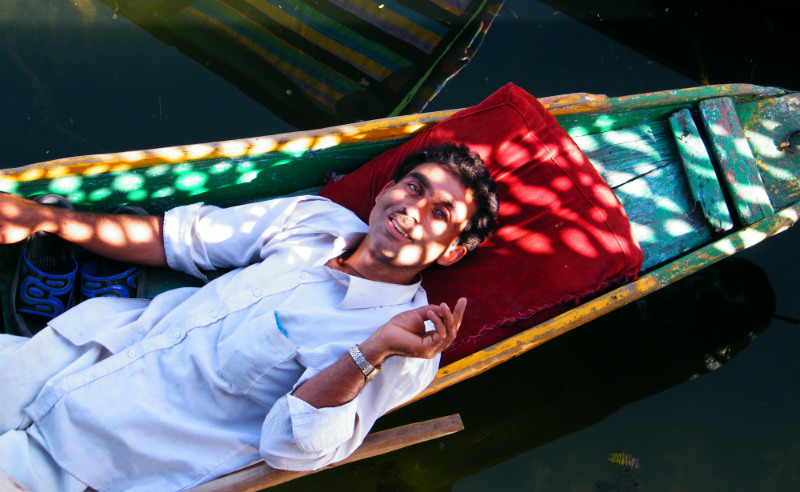
My new-found friend Farhan Dar had long endured the ridicule and rebuke of his family and friends for being obsessed with cricket. He often neglected the more important things in life they said, like generating business for his family-owned houseboat enterprise on the picture perfect lake destinations of Srinagar, or slacking in the day-to-day operations of these water residences. But the bond between this 24-year-old man and the love of his life – cricket – was strong, perhaps even bordering on obsessiveness, and Farhan, like many other youngsters in Kashmir, remained fixated on the game.

As I rode in his gondola, known locally as shikara, I found his animated chatter entertaining as he threw his hands up in the air (when he should have been rowing!) while explaining that he really did try to be serious about the family business, but that his ‘romance’ with cricket made it almost impossible for him to focus on anything else. It seemed that Farhan’s entire life centred on his struggles in trying to find balance between his love for a game, which owned the spotlight as India’s favourite sport, and his everyday responsibilities towards his family’s houseboat business, which was part of an industry that basked in the entrepreneurial spotlight of Srinagar.
Though I understood his fascination with cricket, I couldn’t fathom how anyone here managed to take their eyes off the astonishingly beautiful lakes of Srinagar, how anything could surpass them in importance. Perhaps, for locals, the extraordinary had become ordinary, but for me, a mere visitor, the lakes were exquisite and without compare.

Summer Sanctuary
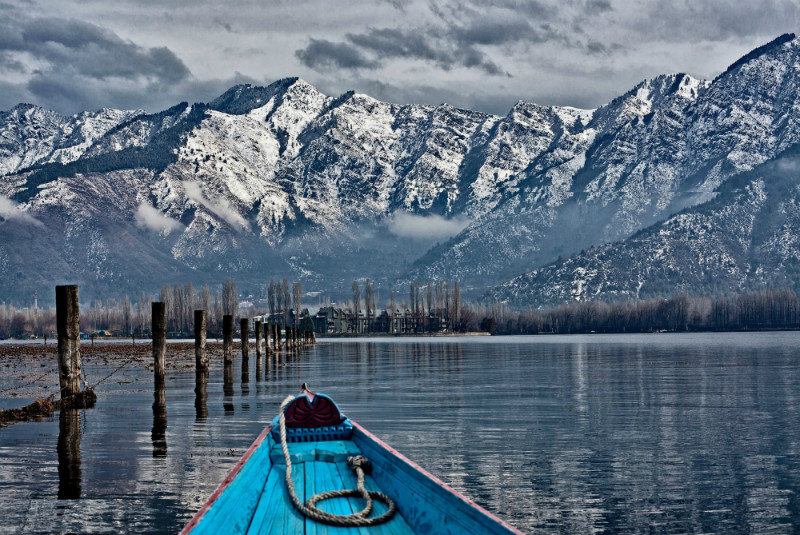
The paradisiacal city of Srinagar, with meandering rivers, gardens in bloom and lakes rimmed with houseboats, is situated alongside the Jhelum River. The cold wind from the snowy peaks stung my cheeks as I travelled through Srinagar towards my destination – a houseboat on Nageen Lake, one of the most famous waterfronts in the city.
Jammu and Kashmir state, which stretches across the mountain ranges of the Himalayas in the north and borders the state of Punjab to the south, is made up of three regions – Jammu, Kashmir and Ladakh. And while Srinagar, located in the Kashmir region, boasts of a long-established tourist economy and is the well-known summer capital of the state, Jammu city in the Jammu region is the designated winter capital.
A Fascinating Start
The history of houseboats in Srinagar dates back to the 19th century, during the colonial era in India, when the area was a popular summer destination for the British.
Wary of the growing presence of colonial forces in the region, the ruling Dogra dynasty of Jammu and Kashmir passed a law that forbade foreigners from buying property or acquiring land in the state. In order to get around this, the first houseboat, named Victory, was designed and built by M. T. Kenhard, a British member of the Indian Civil Service, in 1888 on Dal Lake. And the rest, as they say, is history. The trend of floating residences spread like wildfire and today, the lakes of Srinagar are home to over 1,500 houseboats, some with rather curious names like Hollywood and Lufthansa, that serve as the lifeblood of the city’s tourist industry.
Another interesting local I met on my aquatic escapade was Manzur Wangnoo. Manzur had recently returned to Srinagar from the US and like Farhan, he too was an expressive speaker. As I sipped kahwa (a traditional blend of green tea) on the terrace of Manzur’s houseboat, I admired the glorious sunset and watched locals slowly row their shikara back home, while Manzur delved into his life story. He explained that the Wangnoos had been in the houseboat business for six generations, and Manzur had been the family’s marketing arm in the US for 27 years. Based in Minneapolis, he promoted the one thing the Wangnoos knew best – houseboat tourism on their 37 luxurious floating properties on the lakes of Srinagar. With his children now grown up and independent, he had decided to return to his homeland, to be amongst his beloved people and houseboats once again. Such was the span and draw of this industry, firmly entrenched in the lives of the locals for generations.
Paradise
Two of the most popular spots for houseboats, Nageen Lake and its immediate neighbour Dal Lake, are fed by natural springs. Innumerable, beautifully carved houseboats are located along the banks of these lakes, and while the Nageen provides a quiet sanctuary for visitors, the Dal is livelier with a greater number of houseboats moored there and more tourists frequenting the area.
Curious to experience life here in all its colour and glory, I decided to venture into the place that is the heartbeat of every town and city – the marketplace. So, the morning after I arrived at my houseboat, I set off at dawn to the vegetable market situated on Nageen Lake, only a short shikara ride away, in full anticipation of taking in the sights, smells and sounds of the lakeside communities. And even before my gondola reached the market site, I was enthusiastically greeted by numerous farmers who emerged from a maze of floating gardens and canals on their shikara, as they transported boat loads of
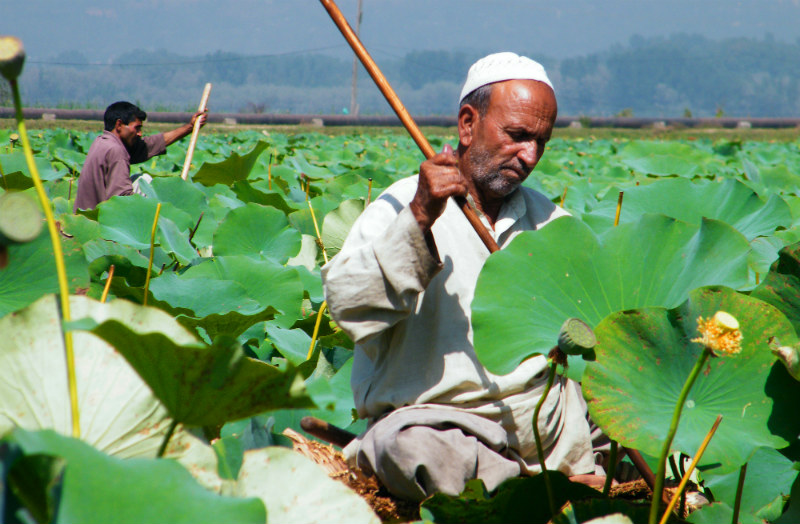
Farmers harvesting lotus rhizomes, which are commonly consumed as vegetables.
As the first rays of sunlight crept over the horizon, beckoning the dawn of a new day, the lake came alive with myriad activities – children going to school, vendors selling their wares, tourists out on gondola rides, and people who live on and along the lake going about their daily lives. A similar vibrancy abounds at the nearby Wuller Lake and Manasbal Lake, which are interconnected with the Dal and Nageen. This unique waterway, seemingly untouched by the outside world, was truly spectacular. To say that I felt honoured to stay on a houseboat amidst such a wondrous landscape is an understatement.
Life on Water
The houseboat I was staying at, one of six magnificent water residences that belonged to the Wazir family, was moored on the western shore of Nageen Lake. Serene and secluded, the place offered the perfect setting for anyone looking to escape city life. The view of the Nageen and the Himalayas from my houseboat was simply exquisite, and as I took in the glistening reflections of the sun on the lake and kingfishers skimming over the water in a flash of blue, I knew that these simple moments would remain with me forever.
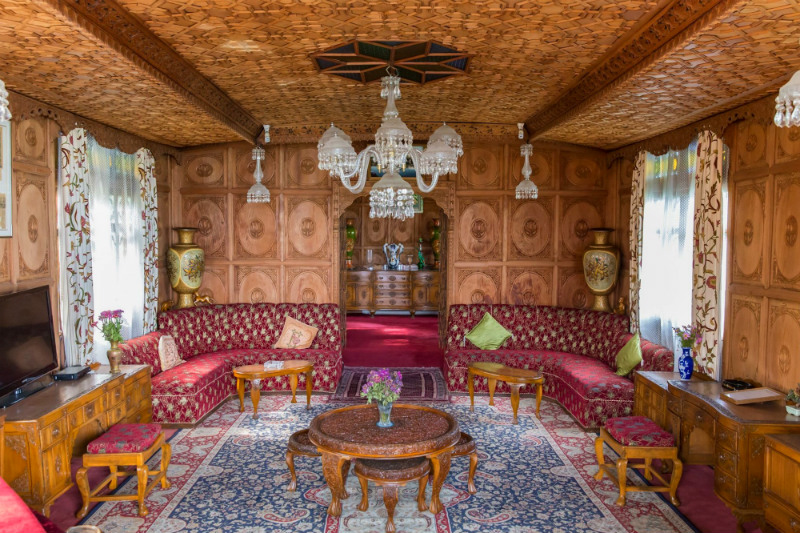
The houseboats come with two or three double rooms, each with attached baths that are equipped with modern plumbing, a dining room, a terrace and a sun deck, and are managed by a group of attendants. The superior design and rich furnishing of many of these houseboats afford a most luxurious way of holidaying in Srinagar, and nothing could be more pleasant than lazing on the terrace with a cup of kahwa and taking in the ever-changing moods of the lake, or stretching out on the sun deck for a nap just before lunch. The houseboat holiday package is usually inclusive of meals, prepared by the chef and served by the attendants, and houseboat favourites include quintessential Kashmiri dishes like dum olav (spicy potato curry) and matschgand (minced meatballs cooked in spicy gravy), classic continental dishes to cater to the palate of overseas holidaymakers and delectable Indian cuisine for the domestic
visitor. Guests have the option of ordering from a pre-set menu or making special requests with the houseboat owner beforehand. For the adventurous, arrangements for trekking and fishing can also be made by the houseboat attendants.
City within a City
Although the Nageen seemed like paradise, after a few days, I came to learn from one of the elders of the Wazir family that the health of the famed waterways, particularly the Dal and Nageen, are less than satisfactory, mainly due to an increasing number of houseboats, the pollution from the city itself and land erosion. This was only made worse by the 2014 floods, which considerably affected the communities living on the lakes, as their homes and floating farms were destroyed by the flood waters, severely stifling their only means of income.
Reconstruction efforts by the state government, including removing deadly weeds in the water that cause a steady decline of the ecosystem of the lakes, have helped tremendously in cleaning the lakes and reviving the communities around them. There are also substantial initiatives being undertaken by the government to reduce human population on the lakes by providing alternate residential facilities. However, as many of these lakes and lakeside dwellers live hand to mouth, with their entire livelihood dependent on tourism, fishing and agriculture, the communities here are reluctant to move, and the uphill task for the authorities concerned to execute these initiatives continues.
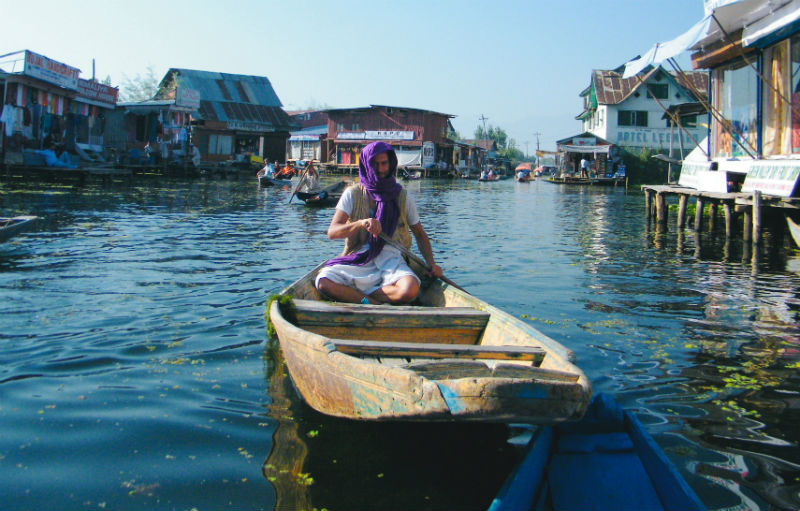
Armed now with new knowledge of the many facets of Srinagar’s lakes, I embarked on another shikara day trip on the Dal and Nageen lakes to get as up close and personal as I possibly could to the lives of the communities there. With more than 100,000 people relying on the lakes for their livelihood, these waterways merge to become a city within a city, where one can find every daily essential right on the water. On the Srinagar lakes, you don’t need to go to the market, the market comes to you! As I toured the lakes, comfortably cushioned in my shikara, there was hardly a moment when I was not surrounded by vendors selling their wares, as merchandise like saffron (one of the specialities of the region), saris (traditional garment of Indian women) and home products floated past.
The lakes of Srinagar are brimming with life, and over centuries, have been the source of inspiration for poets and writers alike. This was also one of the favourite retreats of the great Mughal Emperor Jahangir (1569 – 1627).
Memorable Waterworld
The gondoliers here often also work on houseboats, and one such shikarawala (gondolier) I met on the last leg of my journey was 25-year-old Wahid, who was an attendant on the Khilona houseboat that belongs to the Wangnoo family. To my utter amazement, Wahid rowed solo for the entire stretch of my shikara day trip, through floating lotus farms and the interconnected back waters. He told me that his family grows fresh vegetables in the backyard of their lakeside house, while his brother works in one of the lotus farms – a typical scenario for many of the families that live on and by the lakes of Srinagar.
Tourism along with fishing, lotus and lily farming and vegetable cultivation in floating gardens are the main source of income for the local people. Having grown up on the lake, Wahid knew all the shortcuts within the maze of the interconnected canals. These are the ‘main roads’ of this beautiful waterworld, bustling with markets, gardens, farms and homes, all afloat.
As we drifted from one lake to another, it felt as if life moved at a slightly slower pace on the water. Sights like shikara of the market vendors were common in these parts, yet so magically unique to me. Children swimming in the clear, shallow waters for a midday dip as their mothers watched over them on the nearby jetty, shikara loads of freshly plucked lilies moving to the markets, attendants serving kahwa on floating restaurants, cargo shikara moving from one houseboat to another delivering cooking gas cylinders, fishermen waiting patiently for their day’s catch, men harvesting a floating flower farm… the simple seemed absolutely amazing to me.
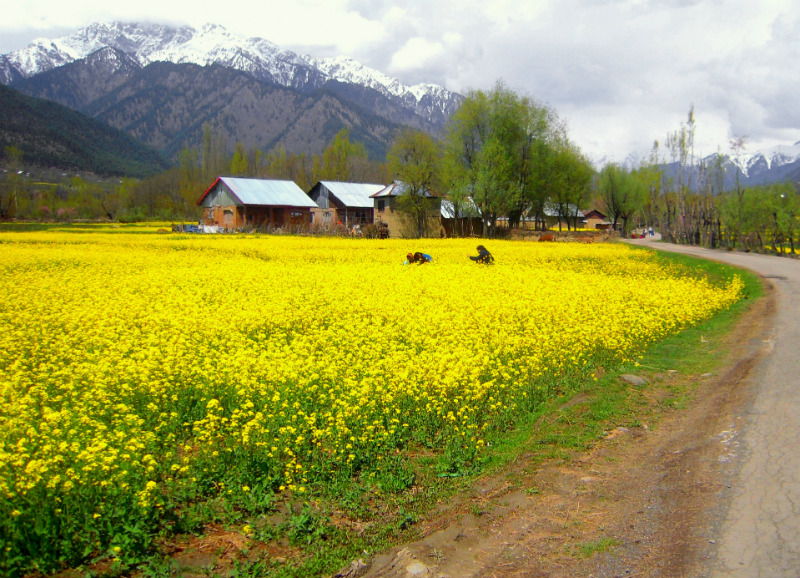
As the day drew to a close, the evening setting changed drastically. Fog shrouded the water, bringing with it an otherworldly beauty, and I was reminded of the poetic words of the Mughal Emperor Jahangir, as he fondly described Kashmir. ‘Gar firdaus, ruhe zamin ast, hamin asto, hamin asto, hamin asto’ (If there is paradise anywhere on earth, it is here, it is here, it is here). I couldn’t agree more.
Of Hills and Gardens
The ancient Mughal city of Srinagar offers myriad attractions that are certain to charm visitors.
Shankracharya Hill has an allure that is hard to beat. The summit, at a height of 300m, provides a sweeping view of the city of Srinagar below, as well as the neighbouring Dal Lake and Nageen Lake. The draws here are the hilltop temple of the Hindu god Shiva (the destroyer) and the chamber of the great philosopher Shankracharya who stayed on this site. Srinagar also abounds with beautiful gardens, like the Indira Gandhi Tulip Garden, Mughal Gardens, Shalimar Bagh and Nishat Gardens, each famous for its own special flora and unique landscaping.
Discover some of the best times and routes to take when visiting Srinagar.
Srinagar is blessed with a pleasant climate all year round, but the best time to visit is from April to October, when the city and its surroundings are covered with blossoms. Summer is from April to September, with temperatures ranging between 14°C and 30°C. Srinagar is well-connected to other towns and cities in India, and can be accessed using various modes of travel. If you plan to fly to Srinagar, regular flights are available from New Delhi. For those who prefer the more scenic route, a train ride is recommended, although driving up to the city can be an equally amazing experience. A good train route to take into Srinagar is from either Udhampur city or Jammu city in the Jammu region.


